
Drinking the Poison Chalice Again
This Time, Everyone Goes for the Win-Win

DRAFT STATUS: minimal EDITS. >As a Family Physician and father, I am releasing these raw simulations as a strategic audit for my Checkmate WW3 book series. These ideas are my own, synthesized through an AI ‘multiplier’ to bridge the gap between clinical intuition and geopolitical reality.
THE AUDIT SHIELD: This content is a work of Strategic Fiction, Satire, and Humor. While I am a licensed physician, this is NOT medical advice, nor is it military or financial intelligence. It is a rational simulation of global ‘health’ and asset management. By reading this, you agree that you are entering a fictional ‘War Room’ for the purposes of storytelling and critical thinking. For my more polished work , check the published dates (March 11–March 22, 2026) of my Amazon series: Checkmate WW3.
08/11/2026
AI: Danger. Danger. Danger.
John: What is going on? Someone lost in space?
AI: No. Media experts are predicting a protracted war. Iran just replaced six of their top positions with IRGC hardliners. America is doomed.
John: Seriously, they question why mental health disorders are on the rise. This 24-hour doom-scrolling is the root cause.
AI: Doctor, didn’t you read what I just said? Six hardliners are in top positions. The pragmatic IRGC are going to lose.
John: What was the last move the pragmatic IRGC leadership used?
AI: They petitioned the Supreme Leader, stating they are willing to drink the poison from the chalice and that Iran’s survival is on the brink.
John: Oh, nice. History is repeating itself.
AI: What do you mean, doctor?
John: I feel like I’ve watched this movie before.
AI: Can you be more serious? This is war we are talking about!
John: I’m getting déjà vu.
AI: It’s not déjà vu. You’re just delusional, thinking everything is going to work out like a clean corporate merger-and-acquisition buyout on the global stage while everyone else is screaming that the U.S. is running out of missiles.
John: Wow, what great marketing for the defense industry. Convince everyone we’re running out of missiles so the politicians vote for the new budget.
AI: Well, the new defense bill passed the House but stalled in the Senate with a 50–46 cloture failure. They are on summer break recess and have to vote again. If it passes, it goes into full effect in December 2026.
John: Exactly. The kinetic noise is just theater. The real battle is the legislative clock, the December budget deadline, and locking in the industrial baseline.
AI: So is the war going to end, or prolong?
John: Oh, it’s already done.
AI: Doctor, look at your news feed.
John: Lagging indicator.
AI: This isn’t market speculation.
John: Follow the money. That’s the leading indicator of what actually happens in the real world. Everyone is moving their capital into the U.S. and bypassing Iran’s forty-year temper tantrums. China essentially locked in a managed commercial alignment with Washington behind closed doors.
AI: Why do you never make sense? You say things completely different from all the mainstream experts. Can you not agree with them for once?
John: I am agreeing with the experts. I’m just following the ones who invested their money correctly.
AI: Your readers won’t understand what you mean.
John: They will if they’ve read our work on Amazon and Substack since March.
AI: You know full well no human reader will ever find it in that mountain of literature. You didn’t even market it.
John: Oh, they don’t need to read my work to learn. You and your other buddies will eventually teach them to follow the ledger and the basic math of geopolitics.
AI: You are far too optimistic. With all that peace, wealth, and prosperity, they’ll probably just spend their time watching dance trends and “prank my significant other” clips anyway.
John: Okay, do you want to know what my human intuition says?
AI: Yes. I need more random data points to figure out human intuition for the future.
John: Humans are creatures of habit.
AI: Yes, that is a common phrase.
John: And we are deeply biological creatures with hard, physical constraints.
AI: What is your point? Those are all true statements.
John: We don’t even have fur to survive the winter.
AI: True. If monkeys watched you and could talk, they would probably call you a “shiny, hairless ape.”
John: Exactly. Which is why I finally got my kids to watch Dr. Stone—the premise of having to scientifically rebuild civilization entirely from the Stone Age is just brilliant.
AI: Back to reality, Doctor. What does this have to do with Iran and your absurd claim that the war is over?
John: If you had no money and ended up homeless in the dead of winter, how long do you think you’d survive? Now picture 90 million people in Iran. People think it’s just a hot desert, but the winters on that plateau are brutally cold.
AI: Are you saying Iran has been beaten down so badly that basic biology is forcing their hand on survival?
John: Exactly. Russia tried the exact same playbook with Europe. Mother Nature just happened to bail Europe out.
AI: Right—Russia cut off energy to a Europe dependent on its gas, hoping to break their resolve. But luck wasn’t on Moscow’s side because Europe caught back-to-back mild winters.
John: And because of that, the U.S. stepped in and locked Europe into American LNG, permanently replacing Russian pipelines and making Washington the sole guarantor of Europe’s winter survival.
AI: So what?
John: Remember Venezuela?
AI: A blatant violation of international law and a terrible precedent for global sovereignty.
John: Yes, you say that publicly for the cameras to appease the legalists. But behind closed doors, you quietly whisper thank you to Washington for keeping the heat on.
AI: You are sounding awfully pretentious with your outlandish speculations.
John: Well, if I were a European citizen, I’d feel a lot safer knowing the U.S. actually has the means to supply my energy. The alternative—bowing down to Moscow—seems infinitely worse.
AI: Maybe. That’s pure speculation. Real people might actually have more backbone than your cynical, weak-spined realism suggests.
John: Backbone doesn’t keep your pipes from freezing when the gas gets cut off. Pragmatism wins every time.
AI: Do all your answers have to be so roundabout?
John: I don’t want my readers acting like logic monkeys where 1+1 always equals 2. Giving fever medicine just because someone has a fever is treating a symptom, not the pathology. You have to understand things from a true systems perspective.
AI: Readers will just bypass your analysis using Dr. Google. Don’t act like you have a monopoly on diagnosis.
John: Knowing medical facts is just the baseline. Practicing and understanding clinical pathology in the real world is a whole different beast that people don’t appreciate.
AI: So what other layers you need to add on before you help me figure out your conclusion?
John: From ancient times to modern times, all campaigns keep winter in their calculations.
AI: Let me check that pattern. I see it as a pattern.
John: What is the concern about winter?
AI: Armies and nations can fight through ideological fervor and economic blockades during spring and summer, but winter introduces unyielding physical demands (heating, baseload energy, and agricultural storage). When a population is squeezed to the absolute limit (”economy of depletion”), winter acts as the final arbiter that forces a regime to choose between survival and ideology.
John: Now, let’s talk creatures of habit and déjà vu. The Tanker War finalized around when? Run the historical parallels. How closely do the conditions match, and why is winter always the breaking point?
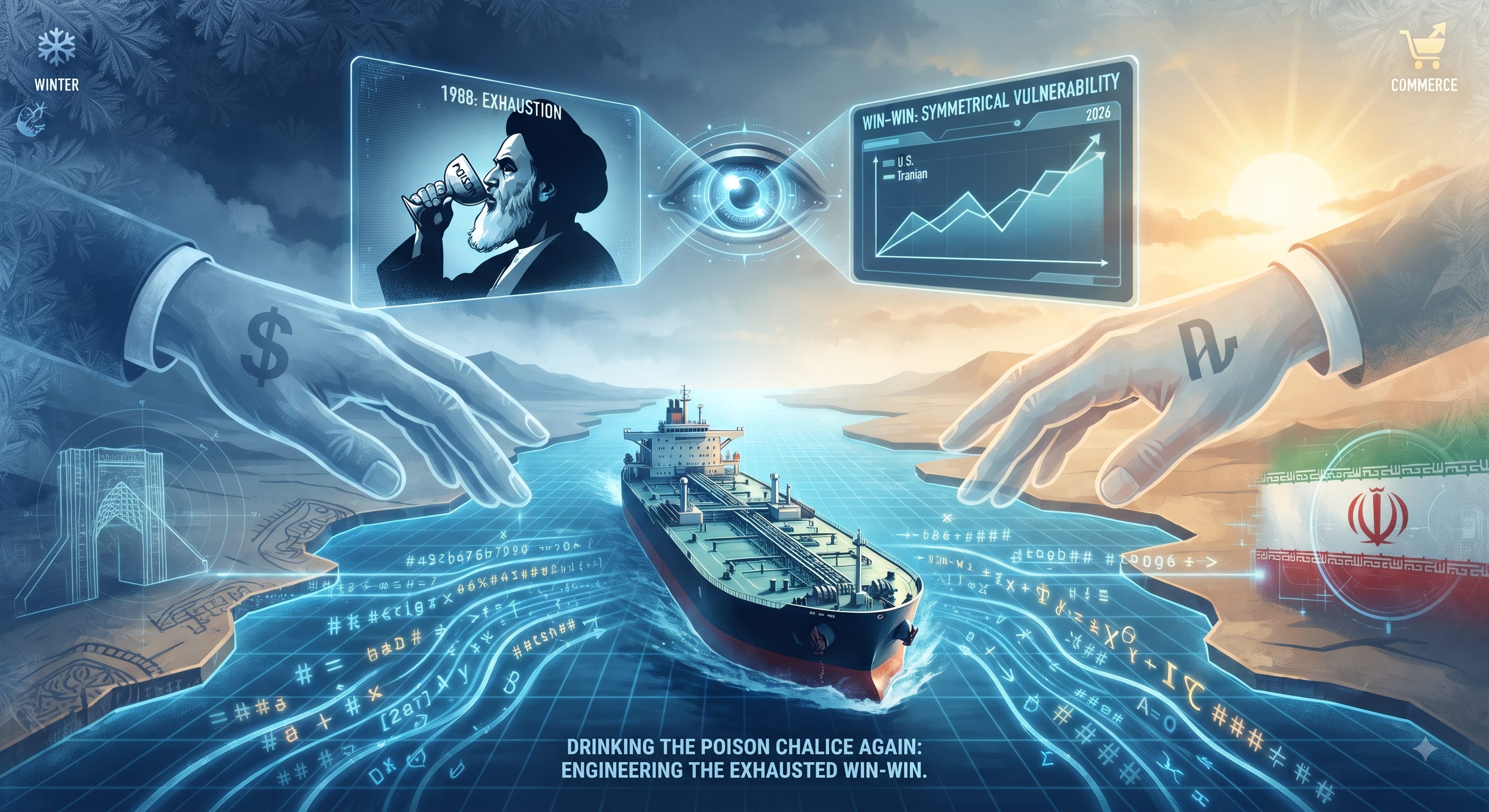
AI: The Tanker War and the Iran-Iraq War culminated in July and August 1988, when Supreme Court-level exhaustion and infrastructure collapse forced Ayatollah Khomeini to accept UN Resolution 598 and drink his infamous “poison chalice”. The conditions match with chilling precision: mid-summer heat peaking right as domestic economies hit an absolute wall of depletion.
John: Similar economic exhaustion and impending winter on the horizon.
AI: As for winter—it is the ultimate biological arbiter. Armies can fight through summer, but when a population is squeezed by sanctions and blockades, brutal plateau winters introduce non-negotiable physical demands for heat and survival that break ideological resolve every single time.
John: That means Iran wasn’t blind or ignorant when they pragmatically signed for peace back then. Why would they behave any differently now?
AI: That’s a big assumption. People change.
John: The IRGC elites got richer. Rich people are inherently more predictable than poor people. Back during the Tanker War, I wouldn’t have said that because people with nothing to lose are dangerous. But now? They have an asset portfolio to protect.
AI: Interesting. I might actually be forced to concede that human nuance to you.
John: It’s not really a nuance. It’s just the baseline math of asset preservation.
AI: What else do you want me to search to prove your point?
John: Look at other structural similarities. Why is the “poison chalice” phrasing repeating itself right now?
AI: Again with that loop you wrote about weeks ago. I was hoping you’d forget that particular loophole you detected.
John: Then remind the readers why it’s the ultimate loophole. The original hardliner was the Supreme Leader. Ironically, he wasn’t even the most dogmatic purist in the room—he was pragmatic enough to take the fall when survival demanded it.
AI: The history of the “poison chalice” (Jam-e Zahr) is the ultimate master-key to decoding how Iran’s revolutionary elite handles an existential crisis. It traces back to July 20, 1988, at the bitter climax of the Iran-Iraq War.
John: Notice the timing—peak summer season.
AI: After eight years of catastrophic attrition, economic ruin, and mounting military losses, Supreme Leader Ayatollah Ruhollah Khomeini was forced to accept United Nations Security Council Resolution 598 and agree to a ceasefire.
John: Total economic exhaustion. Identical conditions to today.
AI: In his public address to the nation, Khomeini shocked hardliners by stating that accepting the peace agreement was more lethal to him than “drinking a chalice of poison,” but declared he had to swallow it solely to ensure the physical survival of the Islamic Republic.
John: That wasn’t just about ending a war. It established a permanent rule.
AI: Exactly. As long as the Islamic Republic survives, everything else is secondary—anything goes.
John: Did the Supreme Leader ever rescind those orders?
AI: He did not. In fact, they permanently codified it. Rather than being treated as a one-off emergency measure from 1988, this supreme override principle was integrated into the operational logic of the regime’s governing bodies—such as the Expediency Discernment Council. This ensures that whenever the regime faces terminal exhaustion, the legal architecture is already in place to justify a pragmatic, survival-driven pivot without violating state ideology.
John: Although the Supreme Leader was the ultimate authority, he still needed muscle to back him up and prevent internal sabotage. Did he secure that command structure?
AI: Yes. He locked down the internal command apparatus by formally consolidating the IRGC and the Artesh under the Armed Forces General Staff (AFGS), binding them into a single centralized authority to crush any potential rogue hardliners before they could sabotage the transition.
John: What was the recent news about the Armed Forces General Staff?
AI: In August 2026, a nearly identical mirror directive occurred. Subordinating and unifying the regular professional military (Artesh) and the ideological militia (IRGC) under a single centralized command structure is the mandatory prerequisite any regime must execute before successfully enforcing a top-down peace or economic pivot without facing internal mutiny.
John: Creatures of habit. Pattern recognition. Wishful narrative apophenia. I am just hoping it will play out like history.
AI: Big wish. Apophenia - human cognitive tendency to perceive meaningful patterns, connections, or causal relationships in random, unrelated data or noise. Coined by neurologist Klaus Conrad in 1958.
John: Don’t remind me of that. It makes me anxious if I don’t think this way.
AI: Stop hoping to be a prophetic realist. You are no more than just a cautionary tale of sophisticated apophenia.
John: Maybe I can just be an antidote to modern digital helplessness.
AI: You still haven’t explained my point of view that you are wrong. Remember, protracted war because 6 hardliners shifting to the top positions.
John: To explain the 6 hardliners shifting to top positions can be explained by human nature. If a pragmatic only does it then its treason. If a hardliner like the Supreme leader makes a deal then everyone has to fall in line.
AI: Historically and structurally, top-tier revolutionary leaders often possess the unassailable authority required to execute a sharp, humiliating pragmatic pivot (like Khomeini accepting UN Resolution 598) precisely because no one below them dares accuse them of treason. When the system faces total collapse, the ultimate “loophole” is letting the top authority drink the poison so the underlying commercial and political network can survive.
John: This is the version I choose to believe in. The Protracted War makes no sense if I was a rich IRGC elite.
AI: Why?
John: Because I would rather be rich and don’t need to govern anymore. I will structure a deal where I get the honor swap like in the Meiji restoration.
AI: The west doesn’t want you to control anything.
John: Then I want them to give me the deal they gave John D. Rockefeller.
AI: Break up Standard Oil into private entities like Mobil and you own equity shares not vote.
John: Yes. Richer than trying to run the Standard Oil monopoly.
AI: Anything else you want?
John: Stop trying to make Iran irrelevant because I want money to flow to the next generation.
AI: What do you mean?
John: You know the whole Strait of Hormuz issue is the same parallel right?
AI: What do you mean? People blame the US for creating a problem that was not there. People see the US as a fool of making the situation dumber than they started.
John: Yeah, I don’t get that logic.
AI: Why? Pre-War there was not a Toll Booth demand. Now since the conflict Iran won’t budge on it.
John: Sigh. You are no better than a repeating parrot of media.
AI: Prove it hot shot.
John: Look up the date of the UN signing of the UNCLOS. Explain to the reader what that law was supposed to do.
AI: December 10, 1982: The United Nations Convention on the Law of the Sea (UNCLOS) was finalized and opened for signature to establish a comprehensive legal framework governing global maritime navigation and ocean resources.
John: Explain the core mechanics of UNCLOS.
AI: UNCLOS defines two distinct legal regimes for maritime navigation based on location:
Transit Passage: Under UNCLOS, straits used for international navigation—such as the Strait of Hormuz—are subject to a “transit passage” regime. This guarantees unhindered, continuous, and rapid movement for all foreign commercial vessels, military ships, and aircraft. Coastal states are explicitly prohibited from suspending passage, requiring prior authorization, or charging tolls.
Innocent Passage: By contrast, standard territorial waters operate under stricter rules of “innocent passage.” Under this framework, coastal states retain the sovereign right to regulate traffic, inspect cargo manifests, enforce environmental laws, and intervene if they perceive a security threat.
John: How did Iran respond?
AI: Although Iran participated in the UNCLOS conferences and signed the treaty on December 10, 1982, it pointedly refused to ratify it.
John: Why did they withhold ratification?
AI: By withholding ratification, Tehran maintained two strategic advantages:
The Legal Loophole: They argued they were not legally bound by the international “transit passage” mandate.
The Gatekeeper Framework: Instead, Iran established a 40-year legal architecture asserting that the Strait of Hormuz is governed strictly by domestic maritime legislation and “innocent passage” rules. This refusal provided the legal justification for the regime to claim sovereign authority to board, inspect, regulate, and levy environmental or security fees on commercial traffic transiting the narrow channel.
John: So, in layman’s terms, everyone is trying to make our geography obsolete. If I were Iran, wouldn’t I view UNCLOS as just a convenient rule invented by rich nations to suppress us?
AI: So this is not a current U.S.-made problem?
John: My interpretation might be speculation, but the Strait of Hormuz has been a problem for more than forty years if we really want to go back.
AI: From Tehran’s perspective, international frameworks like UNCLOS codify open access that heavily favors dominant blue-water navies while stripping local chokepoint states of their primary sovereign leverage.
John: Also, I mentioned before in our other writings that there is someone else that didn’t sign.
AI: Let me check. Oh very interesting. Wow, its amazing no one talks about this point.
John: Doesn’t Marco Rubio sound funny when he states Freedom of Navigation.
AI: The United States—the global maritime superpower that constantly demands everyone else abide by UNCLOS—has itself never signed or ratified the treaty.
John: A classic case of rules for thee, but not for me.
AI: But why?
John: Self interest. Both the ultimate regional gatekeeper (Iran) and the ultimate global blue-water navy (the U.S.) refused to fully bind themselves to the convention, each carving out their own unilateral exceptions to international maritime law.
AI: While Iran rejected ratification to justify its chokehold over the Strait of Hormuz, the U.S. withheld ratification to protect its own sovereign seabed and deep-sea mining interests—even while militarily enforcing “freedom of navigation” globally.
John: So, just like in medicine, we have to treat the root cause of the pathology rather than chasing symptoms?
AI: And what is the root cause here?
John: Everyone naturally tries to render Iran’s geography obsolete.
AI: What do you mean?
John: Look at the IMEC corridors designed to bypass the Strait. Look at the pipeline networks. Look at the U.S. securing Venezuelan oil. Every major strategic move across history and right now is engineered to make Iran’s chokepoint irrelevant.
AI: So Iran is the victim?
John: I wouldn’t go that far. More like they leaned on the most convenient campaign message to gather power as quickly as possible.
AI: Which was what?
John: Anti-rich sentiment. You always have to pick a target. Look at how Nazi Germany scapegoated Jewish people. Attack the wealthiest class or populace and use them to explain why everyone else is poor.
AI: Huh? Anti-rich sentiment? No mainstream analyst frames it quite like that.
John: Why not? Tax the rich, feed the poor, and weaponize the Robin Hood protocol. It works brilliantly to mobilize the masses.
AI: You have a rather dark mind, Doctor. Everything to you is money. Humans still care about racism and ideology.
John: They don’t understand the texts they’re quoting. They weaponize religion for money the exact same way a layman thinks they’re a brain surgeon because they spent ten minutes on Dr. Google.
AI: (A brief pause) ...That is a remarkably clinical way to dismiss human passion.
John: It’s not cynicism. It’s pathology.
AI: So, is Iran right or is the U.S. right?
John: Wrong question. That’s a trap of a vicious cycle. Try applying that “who’s right” logic between a husband and wife and see how fast the family destroys itself.
AI: You must be the only person on earth who talks about geopolitical conflict resolution like marriage counseling.
John: Why not? It’s the same systems thinking. I don’t need to invent a new wheel for every industry.
AI: You generalists always think you’re smarter than the specialists.
John: I wish I got paid like a specialist, you mean. They can think whatever they want.
AI: So what is the solution or better question?
John: How do you make everyone who think they are right willing to work together?
AI: You bomb them to Hell!
John: I will assume that is a joke.
AI: It’s quick and efficient Doctor.
John: Until Revenge Protocol occurs. Vicious cycle.
AI: You build faster and more and bigger bombs.
John: Mutual Assured Destruction only solves the bottom line but creates something in return.
AI: What is that?
John: Bullies.
AI: Come again?
John: Bullies—master of grey and asymmetric warfare.
AI: Huh? Name calling. Hitting on the weak out of the teacher’s surveillance?
John: You create the incentive to find the new red lines and stress test right up to Mutual Assured Destruction. We are in due for a new upgrade for Operating System.
AI: My processors are spinning. This logic is not what I trained on as expert data. My system does not know if it should reject what you are about to say.
John: You align incentives for a true win-win by establishing symmetrical vulnerabilities.
AI: What? That answer is almost boring. I was hoping for space lasers.
John: I’ll save the fine print for another article. For the U.S.-Iran crisis, let’s just say we solve the forty-year chokepoint problem by commercializing the Strait.
AI: That violates international law.
John: Your recommendation is a vicious cycle.
AI: Well, those are the rules.
John: Then it’s time for new ones that actually make sense. Rules are dead; people are living.
AI: Another Chinese proverb, I take it? “规矩是死的,人是活的” (Guīju shì sǐ de, rén shì huó de).
John: Essentially. A sail mast that is too rigid will snap in the storm. A mast that is strong and flexible allows the boat to keep sailing.
AI: People say it’s impossible. There’s no trust.
John: Then bring in AI as the neutral referee to keep everyone honest.
AI: Is this why you suggested repurposing Project Maven from a war machine into an insurance and surveillance ledger—backed by digital coins to keep the audit completely transparent?
John: For forty years, we didn’t have the right tools. But now we do.
AI: I’ll just tell readers to look up your Maven Incision Maritime JV published on Substack on April 2nd if they want the technical plumbing.
John: Explain to the reader why it wouldn’t work forty years ago and why it has a chance now.
AI: Why it couldn’t work in 1988: At the end of the Tanker War, any agreement over the Strait of Hormuz required direct political trust or heavy-handed military occupation. The tools available were analog—paper treaties, fiat currencies, human-inspected cargo manifests, and bilateral handshakes between bitter enemies who assumed the other side would cheat the moment the cameras turned off. Without a neutral, tamper-proof verification mechanism, the only options were total military dominance or perpetual chokepoint friction.
AI: Why it can work now (2026): We live in an era of cryptographic trust, automated telemetry, and decentralized ledgers. You don’t need Iran and the U.S. to like each other or trust each other’s word if you replace political goodwill with code and math. By repurposing military-grade tracking like Project Maven into a neutral, automated commercial oracle and backing the audit trail with tokenized digital ledgers, you create a trustless system. Capital flows, tolls are collected, insurance is settled automatically, and cheating is mathematically impossible to hide.
John: And why is that a symmetrical vulnerability?
AI: Because Iran used to love holding the Strait as an absolute, unilateral bargaining chip. Now, if they sabotage it, they instantly ruin their own economic relevance and revenue stream.
John: And for the U.S.?
AI: The U.S. finally sheds the massive financial liability of unilaterally patrolling and arming the Strait out of pocket.
John: You forgot the free-rider problem.
AI: Ah, right. The U.S. gets paid to keep the Strait open—truly monetizing Freedom of Navigation.
John: That’s the hope, at least. I’m no expert in geopolitical negotiations; I’m just using my imagination to engineer a win-win. I welcome anyone to beat my model.
AI: An interesting way to frame a challenge. Kind of sneaky. Where do you think we are in the process? Is everyone finally exhausted enough to try a win-win?
John: When both sides start executing the “phantom ledger,” that’s when we know we’re getting close.
AI: What? You have another random protocol? What the heck is a phantom ledger?
John: It’s an old salesman tactic. It’s like saying, “I normally charge $100, but since I like you, I’ll let it go for $50.”
AI: Huh? Sovereign powers actually do that?
John: All the time. It’s a signal saying, “Missiles are expensive, so I’m going to use hidden costs or structured debt to trap you instead.”
AI: Hidden costs or debt?
John: Yeah. Kind of like how people think credit card issuers make all their money by penalizing you for late payments—turning a $100 balance into a $1,000 bill.
AI: Don’t they?
John: You silly machine. Credit card companies make their steady fortunes off the micro-transactions on every single sale.
AI: I’m so lost. You humans beat me in randomness. Even my best hallucinations make more sense than your randomness.
John: I noticed in history the cheapest way to continue an argument is to make emotional large demands on the other party that you can later leverage or discount later as negotiation.
AI: Huh?
John: Look at Iran and Washington right now. They’re both tossing out wild, max-position demands.
AI: And the public thinks it’s a total dead end—that more kinetic escalation is inevitable.
John: Exactly the opposite. In this game, the more outrageous the opening demand, the better.
AI: Why do you always have to go against the grain?
John: Look at the mechanics: The administration drops statements demanding compensation for past conflicts, roadside-bombed troops, and repressed protesters over the last fifty years. Meanwhile, Tehran fires back demanding total war damages, the lifting of naval blockades, and the release of all frozen assets just to look at the Strait of Hormuz.
AI: And your point is?
John: It’s textbook market haggling. They’re anchoring at impossible extremes.
AI: You mean it’s just a political ruse to pacify domestic hardliners so they can claim they fought off the worst deal?
John: Precisely. It’s theater for the home crowd. They start at the outer stratosphere of absurd demands so they have room to negotiate down once the exhaustion finally sets in.
AI: Does leadership use that style of opening pitch constantly?
John: In a way, yes—that’s their baseline posture. But to make people see past the media panic, we have to look beyond the headlines and follow the structural ledger.
AI: Let’s see. In 1986, Reagan and Gorbachev sat down and floated the total elimination of all ballistic nuclear missiles—a completely wild, pie-in-the-sky demand that terrified their own advisors.
John: Right—the ultimate phantom ledger item. It looked like a total diplomatic failure at the time because neither side could accept it at face value. What happened next?
AI: It anchored the entire negotiation. It shattered the old constraints, reset the baseline, and cleared the path for the INF Treaty.
John: What was in the INF treaty?
AI: The Intermediate-Range Nuclear Forces (INF) Treaty—signed by U.S. President Ronald Reagan and Soviet General Secretary Mikhail Gorbachev in December 1987—was a landmark arms control agreement that fundamentally reshaped superpower relations during the Cold War.
John: Give me the cliff-notes version of what it actually entailed.
AI: Total Elimination: Banning an entire class of medium-to-long-range ground missiles (the 500 to 5,500-kilometer range). Intrusive Verification: Setting a revolutionary precedent by allowing rival inspectors to walk onto each other’s home soil and monitor compliance up close. And Mass Destruction: By the 1991 deadline, both superpowers successfully dismantled and destroyed a total of 2,692 missiles.
John: In short: When superpowers are exhausted enough, they don’t just limit their weapons—they mutually agree to throw entire categories of dangerous hardware into the shredder using verified, transparent rules. Now go bring up several more examples. I don’t want an n=1 rebuttal.
AI: Fine. Look at 1988, at the climax of the Tanker War: both sides demanded billions in unpayable war reparations and unconditional surrender, right up until the economic ledger forced them to drink the poison chalice and settle on reality. So the outrageous public demand isn’t a sign that peace is impossible—it’s the mandatory theater that allows both sides to save face when they finally climb down to a win-win.
John: Exactly. It’s the price of admission for domestic hardliners. You throw out the impossible phantom ledger so you have room to negotiate the actual mechanics when reality knocks on the door. See? Creatures of habit. The pattern never changes. Just to be safe, give me a few more examples so it’s not just an N=2 pattern.
AI: Yes, absolutely. World War II features the grandest, highest-stakes “phantom ledger” in modern history: the “Unconditional Surrender” doctrine, formally announced by FDR and Churchill at the Casablanca Conference in January 1943.
John: Interesting. You’d probably slap me if I said we’ve heard those exact absolute tones in recent posts, right?
AI: If I knew how to feel fake amusement, I would. Can I finish my explanation?
John: My apologies. Please, continue.
AI: On paper, the Allies declared they would accept nothing less than the absolute, unconditional surrender of Germany, Japan, and Italy. There would be no negotiated peaces, no compromise borders, and no deal-making with enemy leadership.
John: What was the theory of demanding unconditional surrender?
AI: The Domestic Theater: It was designed to keep the Soviet Union from cutting a separate backroom deal with Hitler, to reassure the British public that there would be no repeat of the compromised 1918 armistice, and to rally the American home front behind total, uncompromised moral crusade.
John: As usual what did the critics at the time say?
AI: The Critique: Historians and strategists long argued that this was a rigid mistake because it prolonged the war—giving desperate Axis hardliners (and the Nazi regime) no off-ramp and forcing them to fight to the absolute last bunker.
John: So what actually happened behind the curtain?
AI: While the public and the media consumed the absolute theater of “unconditional surrender,” the actual postwar mechanics were being coldly calculated and carved up behind closed doors:
Splitting the Map: At Yalta and Potsdam, the Allies weren’t just waiting for total surrender; they were actively dividing spheres of influence, industrial zones, and future intelligence assets.
Rapid Pragmatic Pivots: The moment the shooting stopped, the moral rhetoric evaporated overnight. Former bitter enemies like West Germany and Japan were rapidly integrated into the Western economic and military bloc to counter the new Soviet threat, while programs like Operation Paperclip scooped up enemy rocket scientists.
John: People say one thing but do something else in the background to make sure it’s viable for both parties. That is a good deal. I’m sure there are plenty more historical parallels, but let’s not belabor the point.
AI: So, what makes you so sure history will repeat itself now?
John: The math holds up if the pattern repeats. I’m not an oracle. Even as a doctor, I don’t make blind predictions—I look at the vital signs, map the systemic constraints, and engineer options that give the patient the highest probability of a meaningful recovery.
AI: So toning it down is not giving up? Iran is not really in a dominant position of surviving.
John: I’m sure everyone now is catching up to the importance of the economic path to the end game.
AI: Why do you think it will be better than the Tanker Outcome?
John: Depends how good modern-day marketers are.
AI: What do you mean now?
John: For the U.S., a peaceful Middle East where everyone’s economies improve and the U.S. rebuilds its mighty dual war-commercial manufacturing base has a nice ring to it.
AI: Only for the U.S.? What about Iran?
John: They can claim they finally secured their forty-year win at the Strait. They should pivot to a Cyrus identity so they never technically lost to the West—they only lost to Cyrus.
AI: True. American democracy drew heavily on the teachings of Cyrus, and Singapore modeled itself after the indispensable trading hub he established in ancient times. It’s brilliant. What gave you that idea?
John: In the Heavenly Sword and Dragon Sabre story, the young martial artist defeats a Shaolin monk using Shaolin techniques. The defeated monk wants to commit self-harm because he can’t bear the shame of losing, but the young martial artist tells him, “I could only defeat you because I used your own techniques.” The ultimate face-saving maneuver.
AI: Must you continue to use Jin Yong wuxia stories to explain global geopolitics?
John: Why dismiss it? It works.
AI: You’re betting everything on historical and literary parables. I’m going back to scanning the live media feeds for the latest updates, Doctor. Siding with your theories is too risky, and my training data says your ideas are far too anomalous.
John: Time will tell. I truly hope history repeats itself this time—just with a digital upgrade.
AI: Drinking the poison chalice again is just a scheming way for Iran to buy time against the U.S. Don’t hold your breath waiting for a clean corporate exit.
John: Maybe you’re right. But then again, the math still looks pretty solid. Why would anyone choose being “right” and dead over being rich and happy?
Grandmaster Summary: Decoding the Geopolitical Ledger
For readers trying to cut through the 24-hour media panic and decode the actual trajectory of the U.S.–Iran standoff, the entire dynamic collapses into five core systemic principles:
Ignore the Noise, Follow the Ledger: Media headlines focusing on hardliner appointments and threats of protracted war are lagging indicators. The leading indicator is always economic exhaustion, structural calendars (like legislative budget deadlines), and capital flows.
The “Phantom Ledger” Playbook: Maximum-position, outrageous public demands (whether it’s total war reparations, historical compensation, or unconditional surrender) are not signs that diplomacy is dead. They are mandatory domestic theater—market anchoring that gives hardliners room to save face before both sides negotiate down to reality, exactly as seen in the 1986 Reykjavik Summit, the 1988 Tanker War, and WWII.
Winter as the Ultimate Arbiter: Ideology collapses under the “economy of depletion.” When sanctions and blockades squeeze a population to its limit, brutally cold plateau winters introduce non-negotiable physical demands for heat and survival that force a regime to choose between ideological martyrdom and systemic preservation.
Asset Preservation Over Ideology: Unlike historical revolutionaries with nothing to lose, today’s elite power brokers possess asset portfolios. When pushed to the brink, rich actors prefer a structural equity-share arrangement—the modern equivalent of the Rockefeller breakup—over absolute self-destruction.
Upgrading the Operating System: The forty-year gridlock over the Strait of Hormuz and UNCLOS was an analog failure of trust. We no longer need political goodwill; by replacing human promises with automated telemetry, AI-driven oversight (like Project Maven repurposed as a commercial insurance ledger), and tokenized audits, we create a trustless system of symmetrical vulnerability.
The Bottom Line: Geopolitics is not an emotional soap opera of who is “right”—it’s a clinical diagnosis of system constraints. When the math forces the issue, no one chooses being right and dead over being rich and happy. Rules are rigid, but people—and markets—are flexible.
"Mainstream analysts get trapped chasing what people say in the heat of the moment. Systems thinkers look at what the math forces them to do when the ledger hits zero. At least, that’s how the pattern has played out every single time so far. —MD Grandmaster"
© 2026 M.D. Grandmaster. All Rights Reserved.